The Dunkyard looks into how smelly things might get in Atlanta this season as its 2016-17 NBA season preview continues.
Last season by the numbers
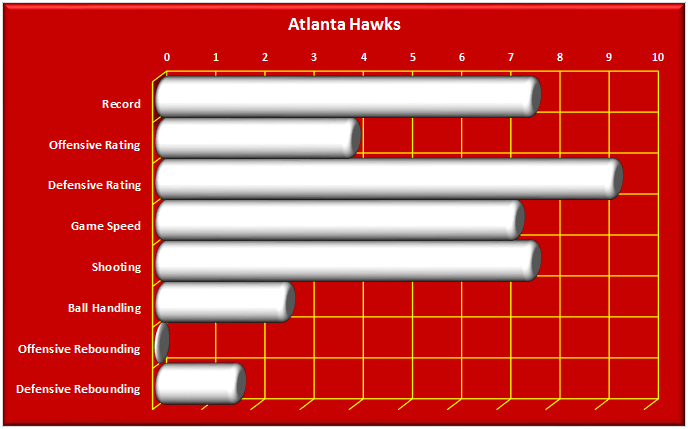
- Record: 48-34 (4th East)
- Offensive rating: 103.0 (18th)
- Defensive rating: 98.8 (2nd)
- Pace: 99.4 (8th)
- True shooting: 55.2% (7th)
- Turnover rate: 13.8% (22nd)
- Offensive rebounding: 19.1% (30th)
- Defensive rebounding: 74.6% (25th)
- Giveashitameter: 23rd
- Highest PER*: 21.3 (Millsap)
(*) – minimum 1,000 minutes.
At a glance
(Converts the above rankings into a rating out of 10).
Recap
The Hawks couldn’t grab a rebound to save their lives. For a team sporting solid front court players in Horford (19.46 PER) and Millsap (21.33 PER), this came as a big surprise.
The big truth was that Horford was simply horrible, ranking 44th among 58 centers on defensive rebounding and 50th on overall rebounding. The amazing thing here is that this represented the EIGHTH season in a row in which Horford’s defensive rebound rate has declined – going all the way back to his rookie season.
While Millsap was better, his 20th ranking on the defensive boards wasn’t enough to make up for Horford’s deficiency and prevent opponents having multiple chances on too many possessions. Making things worse was the fact that Horford and Millsap were the Hawks’ two best rebounders.
Despite this, the Hawks incredibly managed to finish with the league’s second best defense. In particular, they were among the league’s best at guarding the perimeter (6th on three point accuracy allowed) and number one overall on two point percentage allowed. The burning question is, how was this possible for a team that couldn’t rebound and had a 34 year old Kyle Korver playing 2,401 minutes?
The answer was the collective efforts of Horford, Millsap, Sefolosha and Bazemore, who were all well above average on the defensive end and selfless team players. While they couldn’t rebound, they were great at staying in front of their man, switching, executing the Budenholzer trap and helping each other to the point where opponents found it extremely difficult to get the shot they wanted. And if they got another shot, the Hawks were happy to repeat their defensive cycle until the ball fell into their hands.
Unfortunately for Atlanta, the cost of their great defense came at the offensive end, where the opponent’s worst defenders could hide on Sefolosha (12.3% usage rate, 12.4 PER) and, surprisingly, Korver (13.7% usage rate, 9.4 PER) – placing far too much pressure on Millsap, Horford and Teague to play at offensive levels they simply were not capable of.
Also not helping things was the Hawks’ poor ball handling (ranked 22nd), with Schroder (62nd among 77 point guards), Teague (48th) and Bazemore (57th among 72 small forwards) being the worst culprits.
So while the Hawks were efficient shooters, their poor ball handling and lack of firepower turned the overall product into one that was slightly below average (18th).
In the end, the final result was a 4-0 whupping at the hands of LeBron in the second round and the end of the Teague-Horford era in Atlanta.
Reasons to be optimistic
Howard will definitely help with the rebounding. He finished 5th among all centers on defensive rebound rate and was 9th in overall rebounding among centers.
Howard should also be able to more or less maintain Horford’s defensive level at center. All the other major pieces of the Hawks second ranked defense from last season are still there which means the Hawks should be able to defend at the same level as last season.
Reasons not to be
The Hawks let Carroll walk to Toronto before last season – presumably on the basis that they didn’t want to pay him $14 million a season for the next four years. While this may have been understandable at the time, the decision to commit to Bazemore – an inferior player – for $15 million a season over the next four years looks horrible in this context. Carroll could well be the one that got away.
Backing up Dennis Schroder is… Dennis Schroder. Yep, the Hawks have only one real point guard on the roster at the moment. Unless you think Tim Hardaway Jr is the man for the job.
Expecting a 30 year old Howard to undo the career defining stink bomb that he’s laid over the last five years, simply by coming back home to Atlanta, is not sound logic.
To summarise: the Hawks effectively traded Horford and Teague for Howard and Taurean Prince. Would you like me to draw you a picture?
Major Ins
Dwight Howard, Taurean Prince.
Major Outs
Al Horford, Jeff Teague.
The Dunkyard’s recommended ‘death’ lineup
- Schroeder
- Korver
- Bazemore
- Millsap
- Howard
Dave’s lowdown
After deciding to take some unnecessary risks and bareback the off-season, Atlanta finds themselves having contracted the NBA version of chlamydia in Dwight Howard, who hasn’t had a positive impact on any team in the last 5 years. If Dwight can’t rediscover his mojo in his hometown then it’s not going to happen anywhere.
Nobody knows how Schroder will perform now that the keys to the team have been handed to him. Already with a history of pouting and personality clashes, teaming him with Howard, a rapidly declining Kyle Korver and a below league-average SF in Bazemore seems less than ideal. If, as expected, things take a turn for the worse Coach Budenholzer will find himself in the same situation as Paul Walker did – sitting helpless in the passenger seat.
Forecast record: 40-42
Between Howard’s incoming rectal motions and the loss of Teague, the Dunkyard sees regression for the Hawks. The question is whether it’s the first stage of an impending long-term rebuild, or whether the Hawks can find an intervening way to stay relevant – much like they did following the similarly B-grade Joe Johnson-Josh Smith Era.
 The Dunkyard